
The FINE Circle: Loudspeaker Design Tutorial
Loudspeaker driver, tweeter and crossover design
The FINE Circle is a three-part loudspeaker design tutorial originally published in Voice Coil magazine in 2023. Written by Peter Larsen and Vance Dickason, the series demonstrates how LOUDSOFT software can be used across the loudspeaker development process, from driver design and enclosure modelling through to tweeter optimisation and crossover integration.
The three articles cover the design of a loudspeaker system comprising a 6.5-inch woofer in a vented enclosure and a 1-inch silk-dome tweeter. They demonstrate the application of FINECone, FINEMotor PRO, FINESuspension, FINEBox PRO, FINE R+D and FINE X-over, illustrating how modelling, simulation and acoustic measurement can be integrated into a single loudspeaker design workflow.
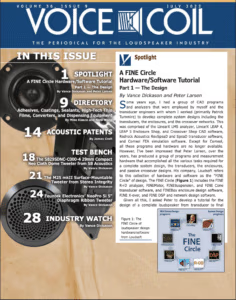
The FINE Circle: Loudspeaker Design Tutorial. Part 1: The Design
By Vance Dickason and Peter Larsen
Voice Coil, July 2023
The first article establishes The FINE Circle concept and begins the development of the two-way loudspeaker.
The design target is an 18-litre bass reflex enclosure containing a 6.5-inch woofer and 1-inch dome tweeter, with a target frequency range of approximately 40 Hz to 30 kHz.
The woofer design uses several FINE programs in combination. FINEBox PRO is first used to define the target Thiele-Small parameters for the enclosure. FINECone is then used for the cone, surround and dust-cap design, while FINEMotor PRO is used for the motor design. FINESuspension is subsequently used to optimise the surround and spider using nonlinear FEA.
FINE R+D is used to measure the resulting woofer and compare the calculated response with the physical prototype.
The article therefore provides a detailed example of how enclosure requirements, cone behaviour, motor performance and suspension characteristics can be developed together as part of a loudspeaker design rather than as separate processes.
Original paper:
A FINE Circle Tutorial. Part 1: The Design
Download the original article
The FINE Circle: Loudspeaker Design Tutorial. Part 2: The Tweeter
By Peter Larsen
Voice Coil, August 2023
The second article continues the loudspeaker design tutorial with the development of the 1-inch silk-dome tweeter for the two-way system.
FINECone is used to simulate the dome, including its on-axis and 30°/60° off-axis response. The initial simulation identifies the first dome break-up mode at approximately 5.1 kHz. A higher dome profile is then investigated to move the break-up products higher in frequency.
The article also examines damping, the effect of a small waveguide using BEM modelling, and the resulting acoustic response. FINE R+D is used to measure the prototype and examine its cumulative spectral decay.
The tweeter motor is then developed using FINEMotor PRO. The article examines both ferrite and neodymium motor configurations and optimises the magnetic circuit and BL(x) behaviour.
The final tweeter achieves a flat on-axis response with a gently declining 30° off-axis response close to the target.
Original paper:
A FINE Circle Loudspeaker Design Tutorial — Part 2: The Tweeter
Download the original article:

The FINE Circle Loudspeaker Design Tutorial. Part 3: The Crossover
By Peter Larsen
Voice Coil, 2023
The third article completes the loudspeaker design tutorial by bringing the woofer, enclosure and tweeter together and developing the passive crossover.
The woofer and tweeter developed in the first two articles are installed in the cabinet and measured using FINE R+D. On-axis and 30°/60° off-axis frequency response, phase and impedance are measured.
The measured responses are then transferred directly from FINE R+D into FINE X-over for crossover development.
The crossover is designed around the measured behaviour of the actual loudspeaker. A second-order low-pass Butterworth filter is used for the woofer, with a 2 kHz crossover frequency, while the tweeter section is optimised against its measured response.
The article demonstrates how measurement and crossover design can be connected directly, allowing the final system to be optimised using real loudspeaker data rather than relying solely on predicted component behaviour.
Original paper:
A FINE Circle Loudspeaker Design Tutorial. Part 3: The Crossover
Download the original article:

What the three-part loudspeaker design tutorial demonstrates
Taken together, the three articles document a complete loudspeaker development process.
The workflow moves from the initial system target through driver and enclosure design, tweeter development, physical measurement and final crossover integration.
System target → enclosure design → cone and suspension design → motor design → prototype measurement → tweeter design → system measurement → crossover design
The important feature of The FINE Circle is the connection between these stages.
The initial enclosure target influences the woofer requirements. The woofer design is developed using FINECone, FINEMotor PRO and FINESuspension. The completed driver is measured using FINE R+D.
The tweeter is then developed and measured, before both transducers are installed in the enclosure. Their measured responses are transferred into FINE X-over, where the final crossover is developed around the actual acoustic behaviour of the system.
This creates a continuous design workflow from component design through to the finished loudspeaker.
From component design to complete loudspeaker
The FINE Circle demonstrates the value of connecting the different stages of loudspeaker engineering.
Rather than designing the driver, enclosure, tweeter, measurement and crossover independently, the process allows information from one stage to be carried forward into the next.
This provides a practical workflow for professional loudspeaker development:
Design → simulate → build → measure → optimise → integrate
The three Voice Coil articles provide a detailed example of this approach, following one loudspeaker design from its initial targets through to the completed two-way system.
The FINE Circle workflow
The FINE Circle brings together the LOUDSOFT tools required for different stages of the loudspeaker design workflow.
FINEBox PRO is used at the beginning of the process to establish the enclosure and system targets.
In Part 1, Inverse FINEBox is used to determine target Thiele-Small parameters for the 18-litre bass reflex enclosure and optimise the low-frequency response.
FINECone is used for acoustic cone and dome design and FEA.
In The FINE Circle it is used for the 6.5-inch woofer cone and for the 1-inch silk-dome tweeter, including analysis of frequency response, directivity and break-up behaviour.
FINEMotor PRO is used for loudspeaker motor design and magnetic FEA.
The FINE Circle uses FINEMotor PRO for both the woofer and tweeter, including optimisation of the magnetic circuit, BL(x), voice-coil induction and motor geometry.
FINESuspension is used to develop and optimise the loudspeaker suspension.
In Part 1, nonlinear FEA is used to examine the surround and spider stiffness and optimise their working range.
FINE R+D connects the simulated design with physical loudspeaker measurements.
The FINE Circle uses FINE R+D to measure the woofer, tweeter and completed loudspeaker, including on-axis and off-axis response and other acoustic measurements.
FINE X-over is used to develop the passive crossover from the measured loudspeaker responses.
In Part 3, measured responses are transferred directly from FINE R+D into FINE X-over, where the woofer and tweeter crossover sections are optimised against their respective targets.
The FINE Circle software suite also includes FINE DSP for DSP and network design.
Together with FINE X-over, this extends the design workflow beyond passive crossover development into digital loudspeaker system design.
Explore The FINE Circle software suite
The FINE Circle provides an integrated set of tools covering loudspeaker transducer design, enclosure design, simulation, FEA, measurement, crossover development and system optimisation.
Explore THE FINE Circle’s LOUDSOFT tools, used across the complete loudspeaker development process:
FINEBox PRO — loudspeaker enclosure and system design
FINECone — cone and dome design and FEA
FINEMotor PRO — loudspeaker motor design and magnetic FEA
FINESuspension — suspension design and nonlinear FEA
FINE R+D — loudspeaker measurement and analysis
FINE X-over — passive crossover design
FINE DSP — DSP and network design
Related LOUDSOFT Software Suites
Related Workflows
Loudspeaker Design and Optimisation Software Workflow
Loudspeaker Simulation Workflow
Automotive Loudspeaker Design Workflow
Loudspeaker Measurement and R+D Workflow
Not sure which Loudspeaker Design Software is right for your application?
Enjoyed our The FINE Circle: Loudspeaker Design Tutorial Papers and want to see more?
Find all our latest news updates on our dedicated Papers page
Geometrical Stiffness of Loudspeaker Cones
AiAIAI Unit-4 Acoustic Design and Measurements
