
AIAIAI Unit-4 acoustic design and measurements
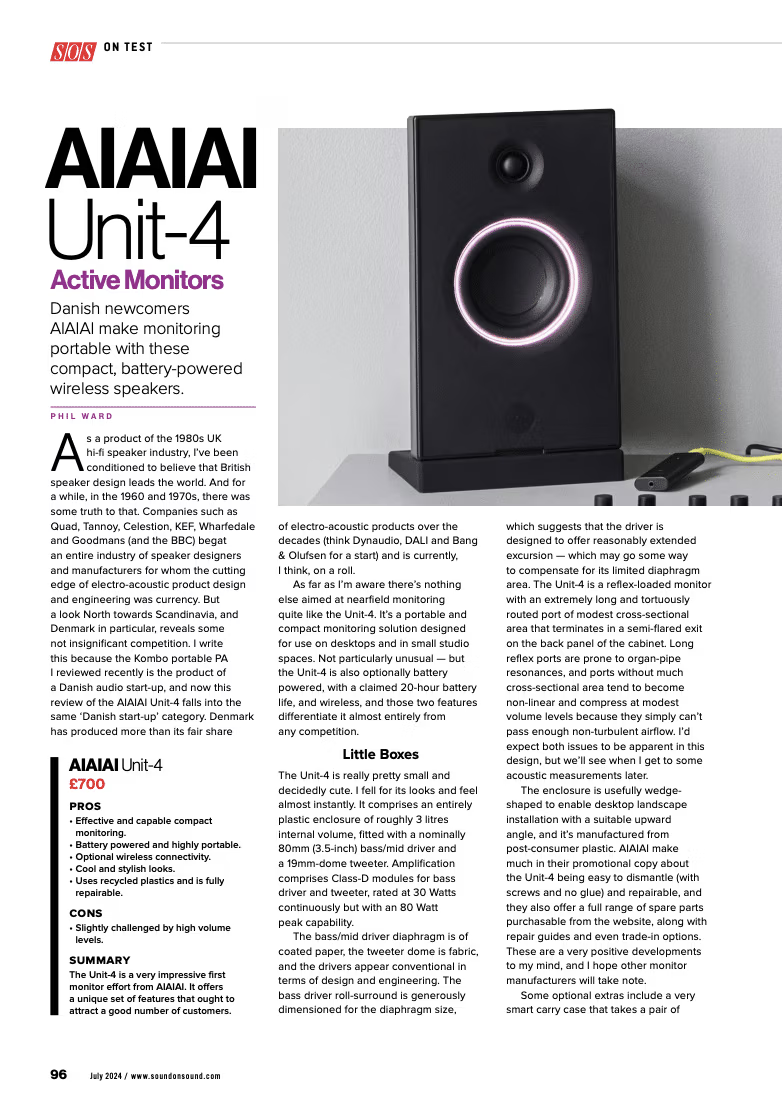
The AIAIAI Unit-4 is a compact, reflex-loaded active monitor designed for portable nearfield monitoring. Its small enclosure combines an approximately 3-litre internal volume, an 80mm bass/mid driver, a 19mm dome tweeter and Class-D amplification rated at 30W continuous and 80W peak.
The July 2024 Sound On Sound review by Phil Ward provides a useful set of acoustic measurements and observations of the Unit-4, including its frequency response, harmonic distortion, off-axis response, grille effects and reflex-port behaviour.
For loudspeaker engineers, one of the more interesting aspects of the design is the unusually long and tortuously routed reflex port used within the compact enclosure. The review demonstrates how the port geometry affects both the acoustic response and high-level performance.
Unit-4 enclosure and reflex-port design
The Unit-4 uses a wedge-shaped plastic enclosure with an internal volume of approximately 3 litres. The enclosure is designed for desktop use and can be positioned in either portrait or landscape orientation.
The bass/mid driver is nominally 80mm (3.5 inches) in diameter and operates in a reflex-loaded enclosure. Rather than using a conventional short port, AIAIAI uses a long, tortuously routed port with a relatively modest cross-sectional area and a semi-flared exit on the rear of the enclosure.
This creates an interesting engineering compromise.
A long reflex port allows the required acoustic tuning to be achieved within a compact enclosure, but increasing port length also introduces the possibility of higher-order acoustic resonances. Similarly, a relatively small port cross-section limits the volume velocity that can pass through the port before airflow becomes increasingly non-linear.
These effects become particularly important when the system is operated at higher sound pressure levels.
Reflex-port resonance
The Sound On Sound measurements identified a clear organ-pipe resonance associated with the Unit-4 reflex port.
Close-microphone measurements of the port output showed a fundamental resonance at just over 400Hz, together with a second harmonic at approximately 800Hz. The review notes that these resonances could contribute some audible coloration.
The result illustrates an important consideration in compact bass-reflex loudspeaker design: the port cannot be treated simply as an element that determines the low-frequency tuning.
Its physical dimensions also determine the acoustic resonances that occur above the fundamental tuning frequency.
Reflex tuning frequency
The measurements indicate a reflex tuning frequency of approximately 50Hz.
This places the enclosure tuning close to the lower-frequency operating range of the compact monitor, while the small driver diaphragm area and available excursion limit the amount of acoustic output that can ultimately be produced at very low frequencies.
The combination of enclosure volume, driver parameters and port geometry therefore has to be considered as a complete acoustic system rather than as independent design variables.
This is a typical enclosure-design problem where simulation can be used to investigate the relationship between driver behaviour, enclosure volume, port dimensions and system response before physical prototypes are built.
Frequency response and harmonic distortion
The Unit-4’s measured on-axis frequency response was described as reasonably flat through much of the operating range, with some variation around the approximately 3kHz crossover region.
A noticeable high-frequency lift was measured between approximately 3.5kHz and 9kHz. The review also measured second- and third-harmonic distortion at 90dB SPL at 1m. The third harmonic was generally approximately 40–50dB below the fundamental through the critical midrange region.
These measurements provide an example of the type of system-level information required when assessing a compact two-way loudspeaker.
Frequency response alone does not describe the complete acoustic behaviour. Distortion, directivity, enclosure effects and port behaviour all contribute to the resulting system performance.
Effect of the grille
The measurements also investigated the effect of the Unit-4’s protective front grille.
With the grille fitted, the measured high-frequency response differed significantly from the response with the grille removed. The review attributes the difference to the interaction between the grille and the acoustic radiation from the tweeter.
This is a useful example of why mechanical details that appear secondary to the primary driver and enclosure design can still influence the final acoustic response.
For production loudspeakers, grille geometry, mounting structures and other components in front of the diaphragm can form part of the acoustic system and should therefore be considered during development.
Off-axis response
The review also measured the Unit-4 at ±15 degrees from the reference axis.
The off-axis measurements show the expected variation through the crossover region as the acoustic outputs of the bass/mid driver and tweeter interact. The measurements demonstrate how the relative phase and directivity of the two drivers affect the system response away from the reference axis.
For a nearfield monitor, this is particularly relevant because the intended listening position, cabinet orientation and vertical or horizontal installation can all influence the measured and perceived response.
System design therefore requires more than achieving a target on-axis frequency response.
High-level performance and port compression
The Unit-4’s compact dimensions impose physical limits on its maximum acoustic output.
The review observed increasing low-frequency compression at higher playback levels and associated this with several interacting limitations, including reflex-port non-linearity, amplifier power and bass-driver excursion.
A small driver has limited diaphragm area, while a compact reflex enclosure restricts both available enclosure volume and practical port dimensions. Increasing input power therefore does not necessarily result in a proportional increase in low-frequency acoustic output.
At higher levels, excursion limits, thermal and amplifier constraints, port airflow and signal processing can all become significant.
Loudspeaker system modelling
The Unit-4 provides a useful example of why loudspeaker development requires the interaction of driver, enclosure and acoustic system parameters to be considered together.
For a reflex-loaded loudspeaker, system modelling can be used to investigate:
enclosure volume
reflex tuning frequency
port length and cross-sectional area
driver Thiele/Small parameters
diaphragm displacement
acoustic output
low-frequency response
port velocity and non-linear behaviour
system sensitivity
high-power performance.
LOUDSOFT FINEBox PRO is designed for loudspeaker enclosure modelling and can be used to investigate bass-reflex system behaviour during loudspeaker development.
The relationship between driver parameters, enclosure volume and reflex-port dimensions can be evaluated before committing to physical prototypes, allowing alternative enclosure configurations to be compared during the design process.
From driver design to complete loudspeaker system
The Unit-4 also illustrates the importance of integrating individual driver and enclosure development into the wider loudspeaker system.
The bass/mid driver, tweeter, enclosure, reflex port, grille, crossover and signal processing all contribute to the final acoustic response.
Measurements such as on-axis frequency response, off-axis response, harmonic distortion and port output provide different views of the same system and help identify interactions that may not be apparent from a single measurement.
For professional loudspeaker development, combining simulation and measurement provides a practical way to move from individual component design to complete system optimisation.
Technical source
This page is based on the July 2024 Sound On Sound review of the AIAIAI Unit-4 by Phil Ward.
The original article contains the complete product review, measurements and diagrams, including the Unit-4 frequency response, harmonic distortion, off-axis response, EQ behaviour and reflex-port measurements.
Original Article: AIAIAI Unit-4 acoustic design and measurements - Sound On Sound, July 2024
Related LOUDSOFT Software
FINEBox PRO
Loudspeaker enclosure design and simulation, including bass-reflex systems and enclosure optimisation.
FINEMotor PRO
Loudspeaker driver motor modelling and FEA for electromagnetic and motor-system development.
FINECone
Loudspeaker cone and dome FEA, including structural behaviour and diaphragm optimisation.
FINE DSP
Loudspeaker system optimisation using measured responses, equalisation and digital signal processing.
FINE R+D
Loudspeaker measurement and analysis for development and system verification.
Related software suites:
Loudspeaker Simulation Software Suite
Loudspeaker System Design and Optimization Software Suite
Related workflow:
Loudspeaker Simulation Workflow
Not sure which software is the best fit for your application?
Enjoyed AIAIAI Unit-4 acoustic design and measurements, and want to see more?
Find all our latest news updates on our dedicated Papers page
The FINE Circle: Loudspeaker Design Tutorial
Geometrical Stiffness of Loudspeaker Cones
